
June 3, 2026
Soccer Pressing Drills for Youth Coaches: 7 Exercises to Teach Collective Pressing
Seven pressing drills for youth coaches, from rondos and press-and-cover work to build-up pressing blocks and conditioned small-sided games.
Quick answer: The best soccer pressing drills for youth coaches teach the pressing trigger first, then build collective pressing shape through small-sided games. Start with rondos to develop the instinct to press immediately after losing the ball, progress to unit-based exercises like 6v4 build-up games, and finish with conditioned small-sided games that reward winning the ball high. Seven complete drills with instructions are below.
Why Most Youth Teams Press Wrong - And How to Fix It
Youth players press the way they think pressing works: everyone chases the ball. The result is a team out of shape, gaps everywhere, and easy passes through the press.
Pressing isn't about running hard at the ball. It's about the team moving as a unit the moment a specific signal - the pressing trigger - occurs. When a defender receives with their back to goal, when the goalkeeper gets the ball, when a player takes a heavy first touch: the whole team presses together, closes the passing lanes, and forces the turnover.
That's what the drills below train. Not individual closing-down skills - collective pressing behaviour. Each exercise isolates a specific aspect of pressing, from the instinct to press immediately after losing the ball to coordinating a high press as a defensive block.
The Pressing Trigger: Teach This Before Any Drill
Before running any pressing exercise, establish one clear trigger with your players. Common triggers for youth teams:
- Back pass to the goalkeeper - team presses immediately
- Ball played to a player facing their own goal - nearest player presses, rest shifts
- Poor first touch - closest player presses, others cut passing lanes
Pick one trigger. Use it consistently across all drills. Players need the trigger to be automatic before they can press collectively.
The 7 Pressing Drills
1. 4v2 Rondo
This drill is in the CoachPage drill library.
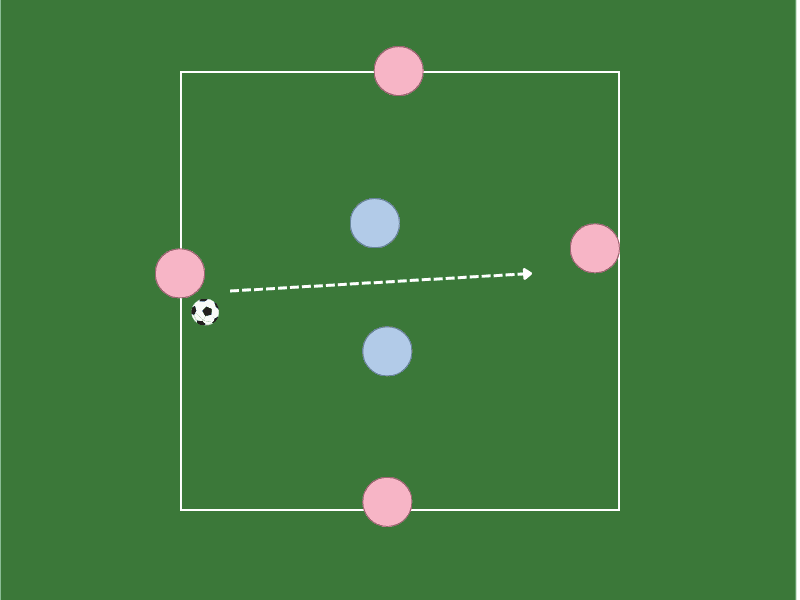
Players: 6 | Focus: Possession + Pressing | Duration: 10 min
Setup: 8x8m grid. 4 outside players maintain possession, 2 defenders press inside.
How it works:
- Outside players keep the ball with a maximum of 2 touches
- 2 defenders press to win the ball - when they win it, they swap with the player who lost it
- A pass that splits both defenders scores a point for the possession team
Why it's the best starting point for soccer pressing drills with youth coaches: The 2 defenders can't press randomly - they must coordinate to close passing lanes together. If one presses the ball and the other doesn't cover the split pass, they concede a point immediately. It's the simplest version of coordinated pressing, and players learn the logic quickly.
Coaching focus: The two defenders pressing as a unit, not individually. Body shape to cut the split pass while pressing the ball.
Variation - 4+1v2: Add a neutral joker inside the grid to create a 4+1v2. The central joker plays with the team in possession, 1 touch only. Forces the defenders to decide whether to press the joker or the outside players. Coming soon to the CoachPage drill library.
2. 4v2 Rondo with Transition to Goal
This drill is in the CoachPage drill library.
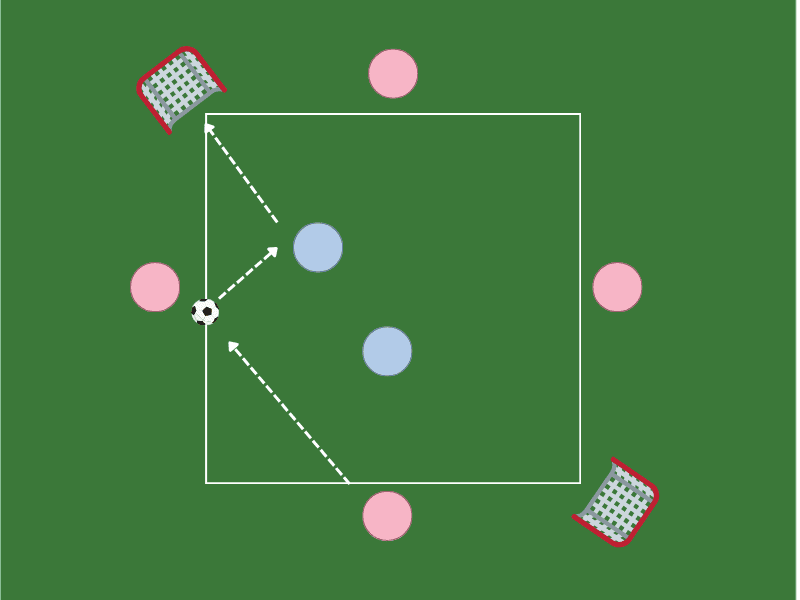
Players: 6 | Focus: Pressing + Transitions | Duration: 10 min
Setup: Same rondo grid, with two mini-goals placed outside on opposite sides.
How it works:
- 4 outside players maintain possession, 2 defenders press inside
- If defenders win the ball, they must score in one of the two mini-goals before the possession team can stop them
- The possession team transitions to defend the moment the ball is won
Why it develops pressing urgency: This is the best drill for teaching youth players that pressing is an attacking action. The defenders aren't pressing to stop possession - they're pressing to score. That mindset shift changes how players press: with purpose and direction, not just effort.
Coaching focus: Immediate counter-attack direction after winning the ball, possession team's reaction speed to defend after losing it.
3. 3v3+1 Improve Defending
This drill is in the CoachPage drill library.
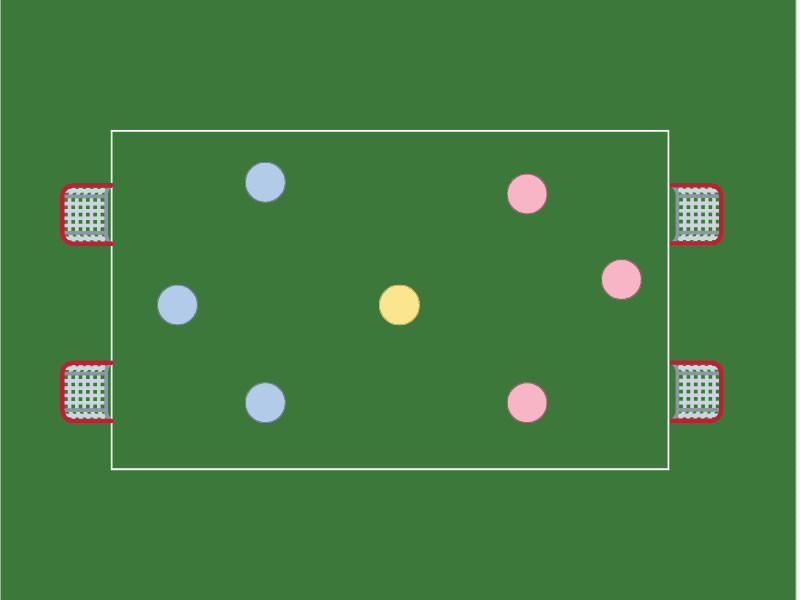
Players: 7 | Focus: Defending + Final Third | Duration: 12 min
Setup: Small pitch with 2 mini-goals on each end. 3 attackers + 1 neutral joker (always with possession team) vs 3 defenders.
How it works:
- Attacking team (3 + joker): 4v3 permanent overload. Attack either of the 2 mini-goals on the opponent's end
- Defending team (3): Press to win the ball and transition to attack the 2 goals on the other end - now supported by the joker
- If the defending team sits too deep, introduce a pass-count rule - X consecutive passes scores a point, forcing the defenders to press rather than drop
Why it's essential for youth pressing: The pass-count provocation rule is the key element. If the defenders sit back, they concede points. They're forced to engage - and they have to do it as a unit of 3, not individually, because the 4v3 overload punishes individual pressing immediately.
Coaching focus: Pressing trigger for the unit of 3, cover and balance behind the pressing player, when to press vs. when to hold shape.
4. 4v1 Defensive Line Press & Cover
This drill is in the CoachPage drill library.
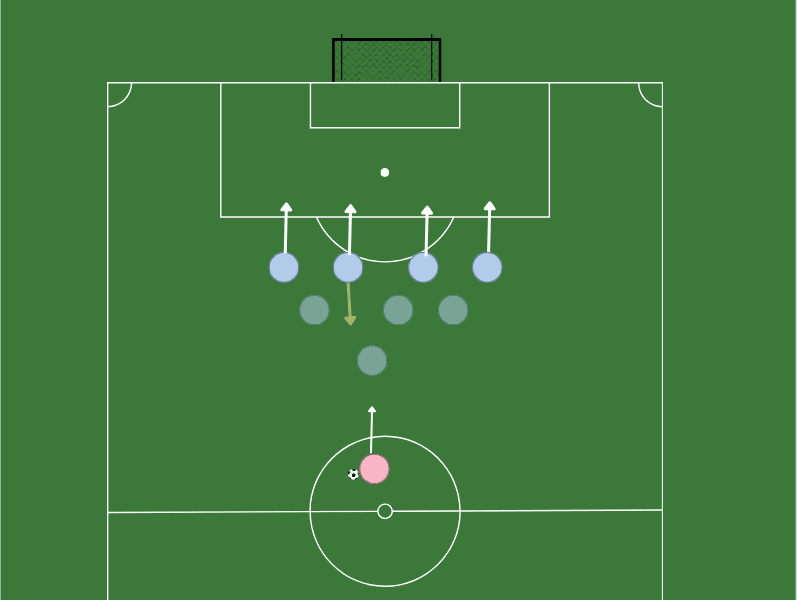
Players: 5 | Focus: Defending | Duration: 10 min
Setup: Half-pitch. 4-player defensive line near the halfway mark. 1 attacker drives the ball forward from the centre circle.
How it works:
- 4-player defensive line drops and holds shape as the attacker advances
- When the ball reaches the edge of the box, the nearest defender steps out to press
- The remaining three tuck in behind and cover - maintaining the defensive line while one presses
Why it teaches the press-and-cover principle: This is the building block of all unit pressing. One player presses the ball. The other three hold the line and cover. Youth players constantly make the mistake of all four following the press - this drill corrects that in isolation before putting it into a game context.
Coaching focus: Which defender steps out (nearest to ball), the other three holding their line, communication between the presser and the cover players.
5. 4v3 Defensive Line Decision Making
This drill is in the CoachPage drill library.
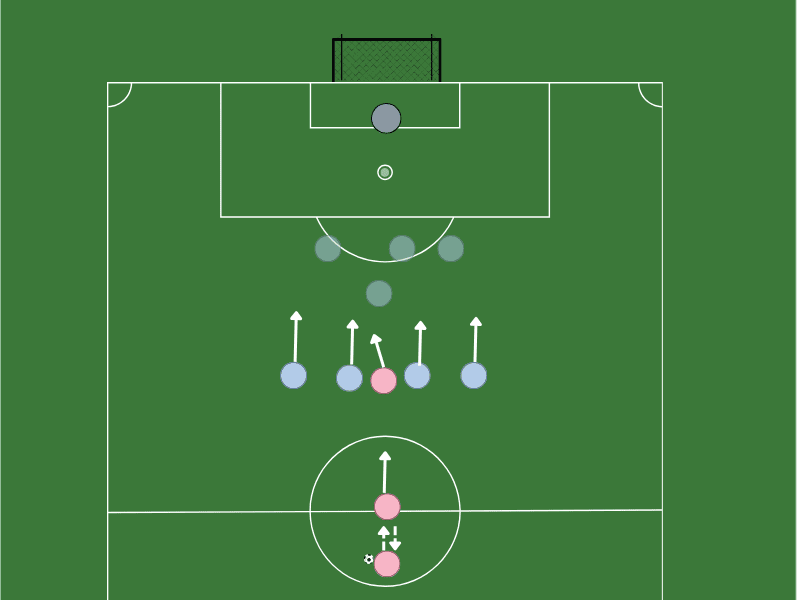
Players: 7 | Focus: Defending | Duration: 10 min
Setup: Half-pitch. 4-player defensive line holding a high block near halfway. 2 attackers passing in the centre circle + 1 attacker inside the defensive line stretching it.
How it works:
- When one attacker drives forward, the defensive line drops toward the box
- Nearest defender steps out to press; the rest close down and cover the runner inside the line
- Attacking team objective: score a goal by combining the run and the drive
Why it's the natural step up from drill 4: Now the defensive unit faces a genuine decision - press the ball carrier while tracking the runner. Youth players typically do one or the other. This drill forces the coordination: one presses, others mark the run and hold the line simultaneously.
Coaching focus: Line communication, tracking the runner without ball-watching, the pressing player's body shape to force play away from the runner.
6. 6v4 Build-Up vs Pressing Block
This drill is in the CoachPage drill library.
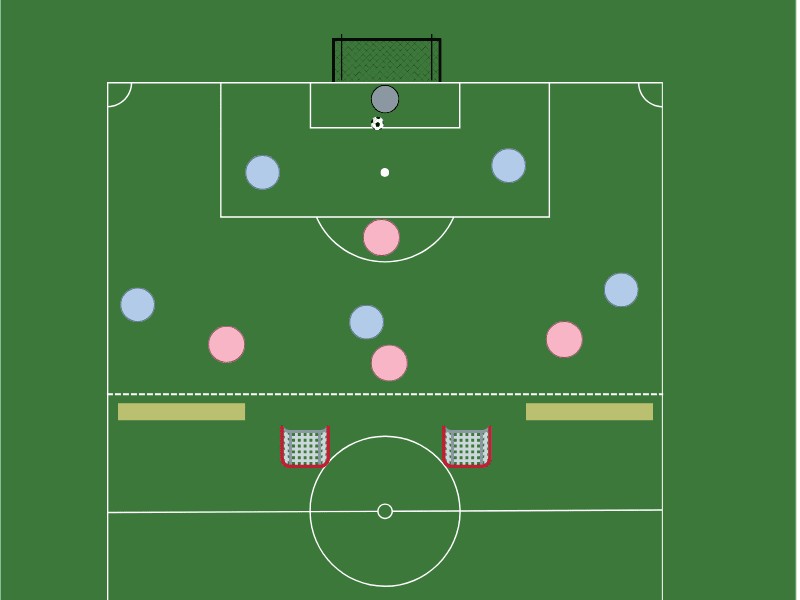
Players: 10 | Focus: Build-Up + Pressing | Duration: 12 min
Setup: Half-pitch. 6 players (1-4-3-3 shape) build from the back. 4 players (pressing block shape) apply high pressure.
How it works:
- Attacking team (6): Build out from the back. Spread the press, find the passing lane, score in mini-goals simulating a pass to midfielders
- Pressing team (4): Apply a coordinated high press. Objective: prevent progression and score in the two mini-goals on the pressing line when they win the ball
Why it's the most game-realistic pressing drill for youth coaches: This is where all the individual and unit pressing concepts come together in a real team shape. The pressing block of 4 must coordinate - who leads the press, who cuts the central lane, who covers wide. Run it from different starting positions so the pressing team learns to recognise different build-up shapes.
Coaching focus: Pressing triggers in build-up play, closing the central lane, collective shift when the ball moves wide.
7. 4v4 Multi-Goal Small-Sided Game
This drill is in the CoachPage drill library.
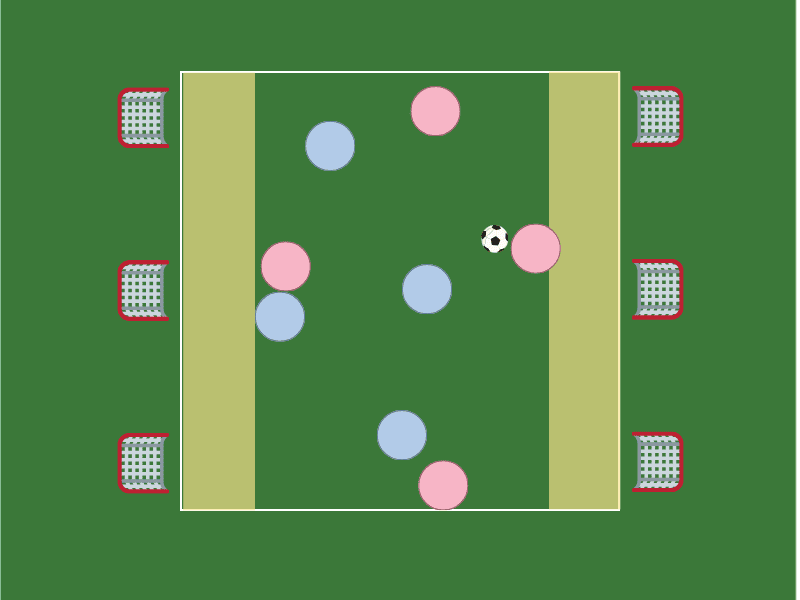
Players: 8 | Focus: Pressing + Transitions | Duration: 12 min
Setup: Pitch with 3 mini-goals on each end line. Two teams of 4.
How it works:
- Each team attacks 3 opponent goals and defends their own 3
- Roles switch instantly on every turnover
- Pressing condition: A goal scored within 8 seconds of winning the ball counts double - rewards teams that press and transition fast
Why it closes a pressing session well: The double-goal condition makes pressing profitable. Teams learn that pressing isn't just defensive - it creates the fastest path to goal. After a session built on pressing unit work, this game lets players apply it freely with a real incentive.
Coaching focus: Transition speed after winning the ball, pressing as a unit of 4 rather than individually chasing.
How to Build a Pressing Session With These Drills
A complete 75-minute pressing session for youth coaches:
| Phase | Duration | Drill |
|---|---|---|
| Warm-up | 15 min | 4v2 Rondo |
| Main Block 1 | 12 min | 4v1 Defensive Line Press & Cover |
| Main Block 2 | 12 min | 4v3 Defensive Line Decision Making |
| Main Block 3 | 12 min | 6v4 Build-Up vs Pressing Block |
| Game | 15 min | 4v4 Multi-Goal (pressing condition) |
| Cool-down | 5 min | Stretch + debrief |
The progression is deliberate: rondo builds the pressing instinct -> line drills teach press-and-cover -> build-up drill applies it in team shape -> game rewards it competitively.
For complete session plans that include pressing drills in a full 90-minute structure, see:
How to Save and Reuse These Pressing Drills
Building a pressing session from scratch every week is slow. CoachPage has all seven soccer pressing drills above in its library - choose the age group and pressing focus, get a first draft instantly, swap in the drills you want, and export a PDF to bring to training. Save it and adapt it in 5 minutes next week.

Build your next training session online with CoachPage
FAQ
At what age should youth players start learning to press?
Basic pressing concepts - close down quickly, cut the passing lane - can start at U10. Coordinated unit pressing (press-and-cover, pressing triggers as a team) is typically introduced at U12-U13 when players have enough tactical awareness to act collectively.
What's the most common pressing mistake in youth football?
Everyone chasing the ball. When one player presses, the rest follow - leaving gaps everywhere. The fix is drills 4 and 5 above, which train the press-and-cover principle explicitly: one presses, the others hold shape and cover.
How do I stop my team from pressing too high and getting caught?
Introduce the pressing trigger before anything else. Players should only press on a specific signal - not whenever they feel like it. Without a clear trigger, high pressing becomes high gambling.
Can I run these drills without mini-goals?
Yes. Use 4 cones per goal (2 per post) for any drill that requires mini-goals. The only thing that changes is the visual - the exercise works identically.
How do I plan my pressing sessions more efficiently?
Most youth coaches spend more time building sessions than necessary. CoachPage has a session builder with the full drill library and PDF export - choose age and focus, get the session, adjust it, and the plan is ready before you leave the house.
Related articles
positional play
Positional Play Soccer Drills: 7 Exercises to Train Juego de Posicion
Seven positional play drills using formats like 4v4+4, 5v6+3, and zonal penetration games to train overloads, free-man play, and transitions.
rondo
You can teach lots of things with 4x2 rondo: here’s how
Practical 4x2 rondo constraints to coach line-breaking, transitions, driving, and third-man actions.
